Bomber!: Famous Bomber Missions of World War II by Robert Jackson
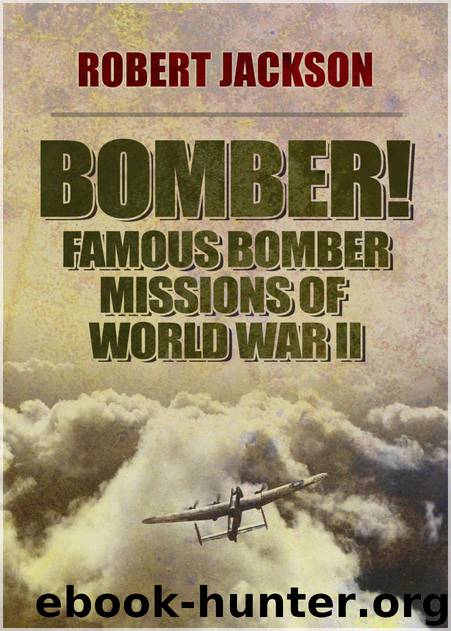
Author:Robert Jackson [Jackson, Robert]
Language: eng
Format: azw3
Publisher: Endeavour Press
Published: 2017-09-28T04:00:00+00:00
8. Mission to Augsburg
On 17 April 1942, the day before Jimmy Doolittle led his bombers to Tokyo, another audacious daylight mission was flown on the other side of the world. The target was the MAN diesel-engine factory at Augsburg, in Bavaria, which was responsible for the production of roughly half Germany’s output of U-boat engines. The Augsburg raid, apart from being one of the most daring and heroic ever undertaken by RAF Bomber Command, was notable for two main things: it was the longest low-level penetration ever made during the Second World War, and it was the first daylight mission flown by the Command’s new Lancaster bombers in the teeth of strong enemy opposition.
The prototype Avro Lancaster had been delivered to the RAF for operational trials with No. 44 Squadron at Waddington in September 1941. On 24 December it was followed by three production Lancaster Mk 1s, and the nucleus of the RAF’S first Lancaster squadron was formed. In January 1942 the new bomber also began to replace the Avro Manchester of No. 97 Squadron at Coningsby — not before time, for in eighteen months of operations those flying death-traps, whose unreliable Rolls-Royce Vulture engines were prone to bursting into flames without warning, had cost the lives of a lot of aircrew. Nevertheless, the Manchester’s basic airframe design had been good, and had given birth to the Lancaster.
Four aircraft of No. 44 Squadron carried out the Lancaster’s first operation on 3 March 1942, laying mines in the German Bight, and the first night-bombing mission was flown on 10-11 March when two aircraft of the same squadron took part in a raid on Essen. In all, fifty-nine squadrons of Bomber Command were destined to use Lancasters during World War II: this splendid aircraft was to be the sharp edge of the RAF’S sword in the air offensive against Germany. Powered by four Rolls-Royce Merlin engines, the Lancaster carried a crew of seven and had a defensive armament of ten .303 Browning machine-guns. It had a top speed of 287 mph at 11,500 feet and could carry a normal bomb load of 14,000 lbs — although later versions could lift the massive 22,000-lb ‘Grand Slam’ bomb which was used to pulverize ‘hard’ targets towards the end of the war.
Because of the havoc wrought by Hitler’s U-boats, the MAN factories at Augsburg had long been high on the list of priority targets. The problem was that getting there and back involved a round trip of 1,250 miles over enemy territory, and the factories covered a relatively small area. With the navigation and bombing aids available earlier, the chances of a night attack pinpointing and destroying such an objective were very remote, and a daylight precision attack, going on past experience, would be prohibitively costly.
Then the Lancaster came along, and the idea of a deep-penetration precision attack in daylight was resurrected. With its relatively high speed and strong defensive armament, it was possible that a force of Lancasters could get through to Augsburg if they went in at low level, underneath the German warning radar.
Download
This site does not store any files on its server. We only index and link to content provided by other sites. Please contact the content providers to delete copyright contents if any and email us, we'll remove relevant links or contents immediately.
Waking Up in Heaven: A True Story of Brokenness, Heaven, and Life Again by McVea Crystal & Tresniowski Alex(37764)
Empire of the Sikhs by Patwant Singh(23057)
We're Going to Need More Wine by Gabrielle Union(19020)
Hans Sturm: A Soldier's Odyssey on the Eastern Front by Gordon Williamson(18551)
Leonardo da Vinci by Walter Isaacson(13287)
The Radium Girls by Kate Moore(12001)
Tools of Titans by Timothy Ferriss(8346)
Educated by Tara Westover(8032)
How to Be a Bawse: A Guide to Conquering Life by Lilly Singh(7455)
Permanent Record by Edward Snowden(5807)
The Last Black Unicorn by Tiffany Haddish(5614)
The Rise and Fall of Senator Joe McCarthy by James Cross Giblin(5257)
Promise Me, Dad by Joe Biden(5127)
The Wind in My Hair by Masih Alinejad(5069)
A Higher Loyalty: Truth, Lies, and Leadership by James Comey(4937)
The Crown by Robert Lacey(4783)
The Iron Duke by The Iron Duke(4333)
Joan of Arc by Mary Gordon(4076)
Stalin by Stephen Kotkin(3937)
